Zero Trust
Verify every user, device, and network. Before they reach anything.
Zero Trust is not a product. It is the principle that nothing on your network is trusted by default. Every access request is verified — user identity, device health, location, and context — before a connection is allowed. FCI deploys this model pragmatically for firms with distributed field operations.
Zero Trust means no user, device, or network is trusted by default — every access request is verified before a connection is allowed. FCI deploys and manages complete Zero Trust for financial-services firms, covering users, endpoints, networks, and cloud applications, with continuous enforcement and the persistent evidence regulators and cyber insurers expect.

FCI’s approach to cybersecurity is aligned with the Zero Trust Maturity Model 2.0, published in April 2023 by the Cybersecurity and Infrastructure Security Agency (CISA). The ZTMM defines five pillars — Identity, Devices, Networks, Applications & Workloads, and Data — plus cross-cutting capabilities including visibility, automation, and governance. FCI’s six security domains map directly to this framework, translating federal guidance into the specific controls, enforcement, and evidence that financial services regulators expect.
Read the CISA ZTMM 2.0The Problem
When one device is compromised, Zero Trust determines how far the damage spreads.
In a traditional network model, a compromised device in a branch office or field agency has access to everything that device user normally reaches. Client data. Internal systems. Other network connections. Once inside the perimeter, the device is trusted — and so is the attacker using it.
For financial firms with dozens or hundreds of field locations, this is not a theoretical risk. Every location is an entry point. Every unverified device is a potential pathway to client data. And most vendors cover only one area of Zero Trust — creating gaps attackers exploit.
Once inside the perimeter, users and devices are implicitly trusted. A compromised laptop in one branch can reach every system the user normally accesses — and the attacker inherits that access without restriction.
Most vendors cover one area of Zero Trust and call it complete. MFA on one application. A VPN for the network. Endpoint protection on some devices. The gaps between these point solutions are exactly where attackers operate.
Every branch office, every independent rep, every home office is a network entry point. Without systematic verification of every access request, distributed operations create distributed risk.
Firms claim Zero Trust on compliance questionnaires but cannot produce evidence that every access request is actually verified. Regulators and cyber insurers are no longer accepting self-attestation alone.
The Principle
Never trust. Always verify. Contain the blast radius.
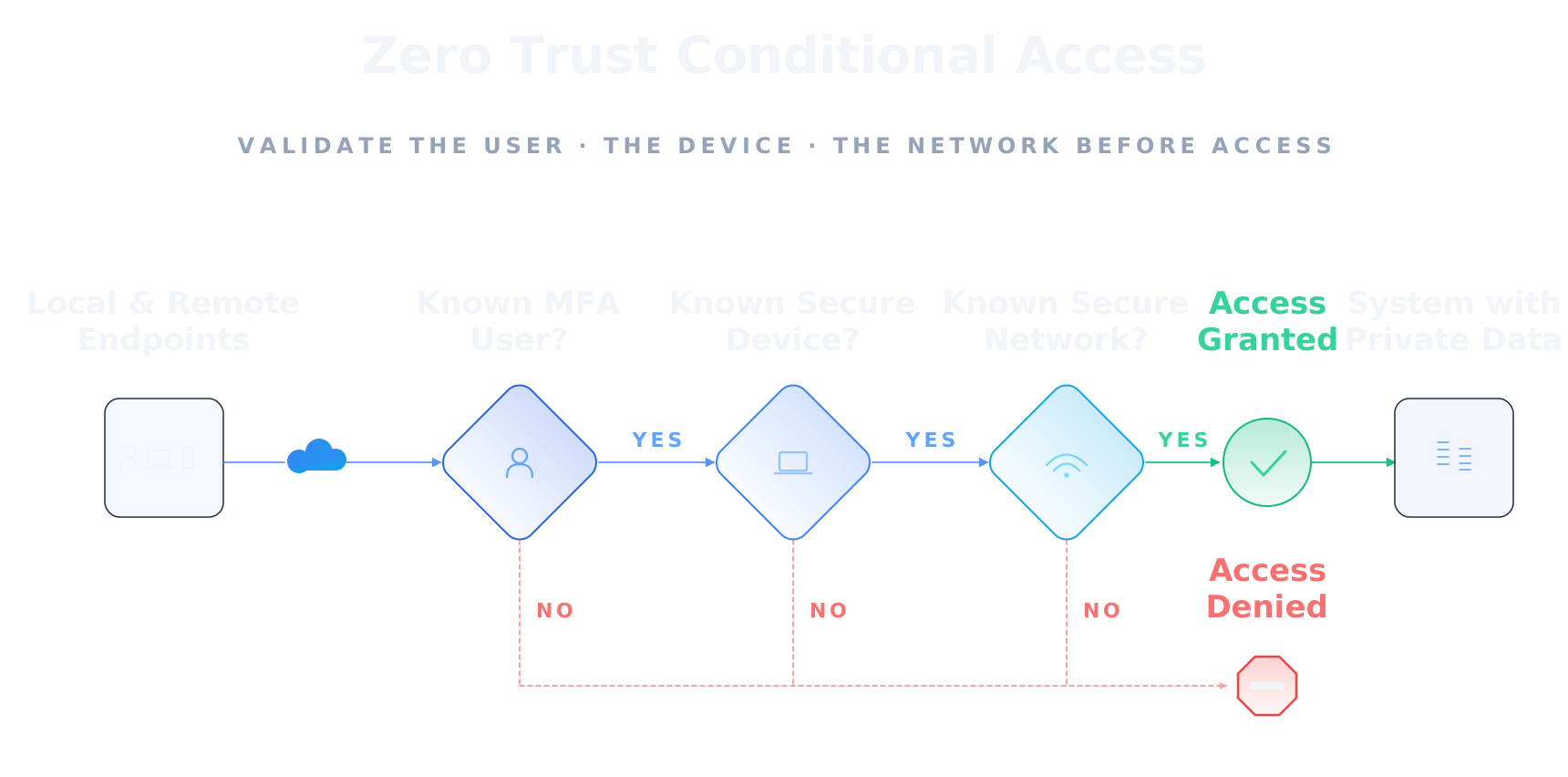
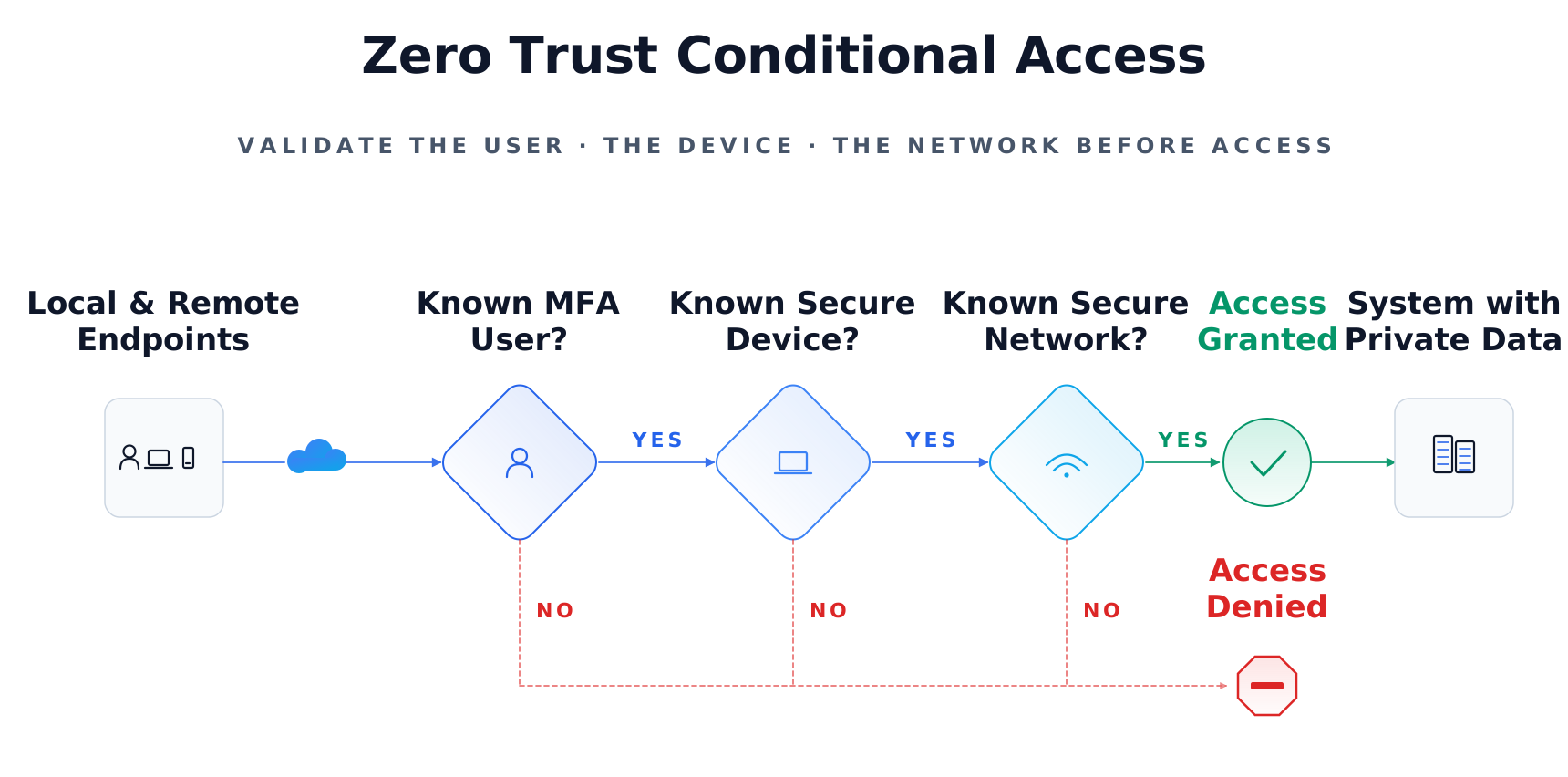
Zero Trust is not a single product you purchase. It is an architecture — a principle applied across your entire environment. Every access request is verified: user identity, device health, network location, and application context. If anything fails verification, access is denied. If a device is compromised, it can reach nothing it has not been explicitly authorized to access.
The blast radius of any incident is contained at the source. A compromised device in one branch stays in that branch — it cannot reach other locations, other users, or other systems. For financial firms with distributed field operations, Zero Trust is not a luxury. It is the architecture that makes those operations defensible.
There is confusion about the term Zero Trust. Some vendors cover one area and others cover a different area — this piecemeal approach does not work. Having Zero Trust in one area only is not complete Zero Trust.
Zero Trust is not a single tool. It is a framework applied across users, endpoints, networks, and applications — working together as a verification system.
Multi-factor authentication is one component. True Zero Trust verifies the device, the network, the application, and the user — all at once, continuously.
Traditional security builds a wall around the network. Zero Trust assumes the wall has already been breached — and limits how far the damage can spread.
Access is not granted once and assumed safe. Device health, user behavior, and network context are evaluated continuously throughout every session.
Zero Trust Complete
Four areas — all integrated, all enforced, all producing evidence.
FCI delivers a genuinely integrated solution that covers all four areas of Zero Trust for financial services firms. Not four separate tools bolted together. Not MFA labeled as Zero Trust. Four areas operating as a single verification system — with evidence that proves it.
Verifying that only authorized users can access private data, endpoints, software, and networks. Phishing-resistant MFA is enforced at every access point — not optional, not user-configured. Deployed and maintained by FCI — consistently, without drift. Aligned to CISA's guidance on phishing-resistant authentication and the Zero Trust Maturity Model.
Automating enforcement of cybersecurity settings and advanced endpoint protection across every device in the environment. Every device requesting access is verified against a current health baseline — encryption status, patch level, endpoint protection active — before a connection is allowed. BYOD and corporate devices held to the same standard.
Enforcing secure and encrypted communication inside and outside corporate networks. FCI's Always-On VPN ensures every session runs through managed, encrypted tunnels — automatically, without requiring the user to connect manually. Every connection is logged. Regulators see consistent, verifiable evidence of encrypted access.
Hardening software and validating user, endpoint, and network compliance at the time of login to systems with private data. FCI's Web App Security Gateway stops unknown users, unknown devices, and unknown networks from accessing systems of private data. Unknown devices are blocked. Non-compliant endpoints are denied.
How FCI Deploys Zero Trust
Pragmatic deployment for firms that do not have enterprise security teams.
Zero Trust is often described as an aspiration — something large enterprises work toward over years. FCI makes it operational for financial services firms of any size. The deployment is automated. The enforcement is continuous. The evidence is produced as a byproduct of how the controls operate.
Every advisor and rep session runs through FCI's managed VPN — automatically, without requiring the user to connect manually. Every session is encrypted. Every connection is logged. Regulators see consistent, verifiable evidence of encrypted access across the entire network.
Multi-factor authentication enforced on every device and every access point. Not optional. Not user-configured. Deployed and maintained by FCI — consistently, without drift. Aligned to CISA's Phishing-Resistant MFA guidance and the Zero Trust Maturity Model.
Every device requesting access to firm systems is verified against a current health baseline — encryption status, patch level, endpoint protection active. Devices that fall out of compliance are flagged before they create exposure. BYOD and corporate devices held to the same standard.
Access is granted by role, office, and supervisor — mapped from your directory services. Field advisors reach what they need. They cannot reach what they do not need. A compromise in one location stays in one location.
FCI validates the cyber posture of a device before allowing it to access systems of private data. Unknown devices are blocked. Non-compliant endpoints are denied. Integration with web application identification ensures the right users on the right devices from the right networks reach the right systems.
Wrapped around the entire Zero Trust ecosystem, FCI's Security Operations Center provides continuous monitoring and incident response support. Every alert reviewed by trained analysts — not just automated scripts. The human layer that ensures nothing falls through the cracks.
Complete Zero Trust — not piecemeal, not partial, not aspirational.
Interconnection
Zero Trust is not a standalone domain — it is the architecture that connects all six.
Each of FCI's six security domains implements its own layer of Zero Trust verification. An endpoint must be compliant before it connects to the network. A user must be authenticated before they reach an application. A network connection must be encrypted before it carries data. Together, these layers form an integrated system where no single failure defeats the defenses.
No single domain failure defeats the system. Every layer reinforces every other layer. That is Zero Trust in practice, not in theory.
What You Can Prove
Evidence that every access request is verified — every day, not just on audit day.
Regulators, home offices, and cyber insurance carriers all ask the same question: can you prove your Zero Trust controls are actually working? FCI produces continuous evidence as a byproduct of how the controls operate. There is no scramble before an exam. The proof already exists.
Zero Trust — common questions
Ready to see what Zero Trust looks like when every area is covered?
FCI works with broker-dealers and branch offices, insurance carriers and agencies, and RIAs. Start with a Zero Trust assessment — see where your firm stands today across all four areas.