Firm Security
The operational backbone — visibility, control, and evidence across every domain.
24×7 SOC, incident response, the FCI Portal, and the coordination that makes every security control work as one integrated service. Not a dashboard. A command center.
Firm security is the operational backbone of a cybersecurity program — the visibility, control, and evidence layer that makes every other security domain work as one integrated service. FCI delivers it through the FCI Portal, a 24×7 U.S.-based SOC, incident response, and security officer support for financial services firms.
The Problem
Your security officer’s job is growing faster than any human can keep up with.
The security officer role has expanded massively — more regulations, more devices, more distributed offices, more documentation requirements. At the branch or agency level, many security officers inherited the role without formal training. At the home office, experienced CISOs face a different problem: the program they wrote is enforced wherever the home office team can see, but every branch, every agency, every advisor device in the field is a question mark.
And when an incident hits, most firms discover their IT provider cannot perform forensic investigation, preserve evidence, or manage regulatory notification.
The security officer’s job spans six domains, multiple regulators, cyber insurance requirements, and home office audits. The documentation requirements alone can consume more time than the actual security work.
Decommissioning a device, onboarding a user, producing audit evidence — tasks that should take minutes take hours or days without automation. Every manual step is a potential compliance gap.
Security data scattered across endpoint tools, cloud dashboards, network logs, and spreadsheets. No single place to see the firm’s complete security posture.
When a cyber event occurs, most firms discover their IT provider cannot perform forensic investigation, preserve evidence, or manage regulatory notification. FCI has seen providers delete forensic evidence during response — the digital equivalent of wiping fingerprints from a crime scene.
What FCI Delivers
Six capabilities that turn firm security from a to-do list into an operational backbone.
Does your current arrangement give your security officer a complete, current, framework-mapped picture of the firm’s posture — or a scramble every time someone asks?
Where the firm’s security posture becomes visible.
The FCI Portal is the operational layer of every FCI service. Real-time visibility across all six domains. Direct control over any device without calling support. Continuous evidence mapped to the frameworks examiners recognize. The firm owns the program; the FCI Portal makes it enforceable and provable to every device it applies to.
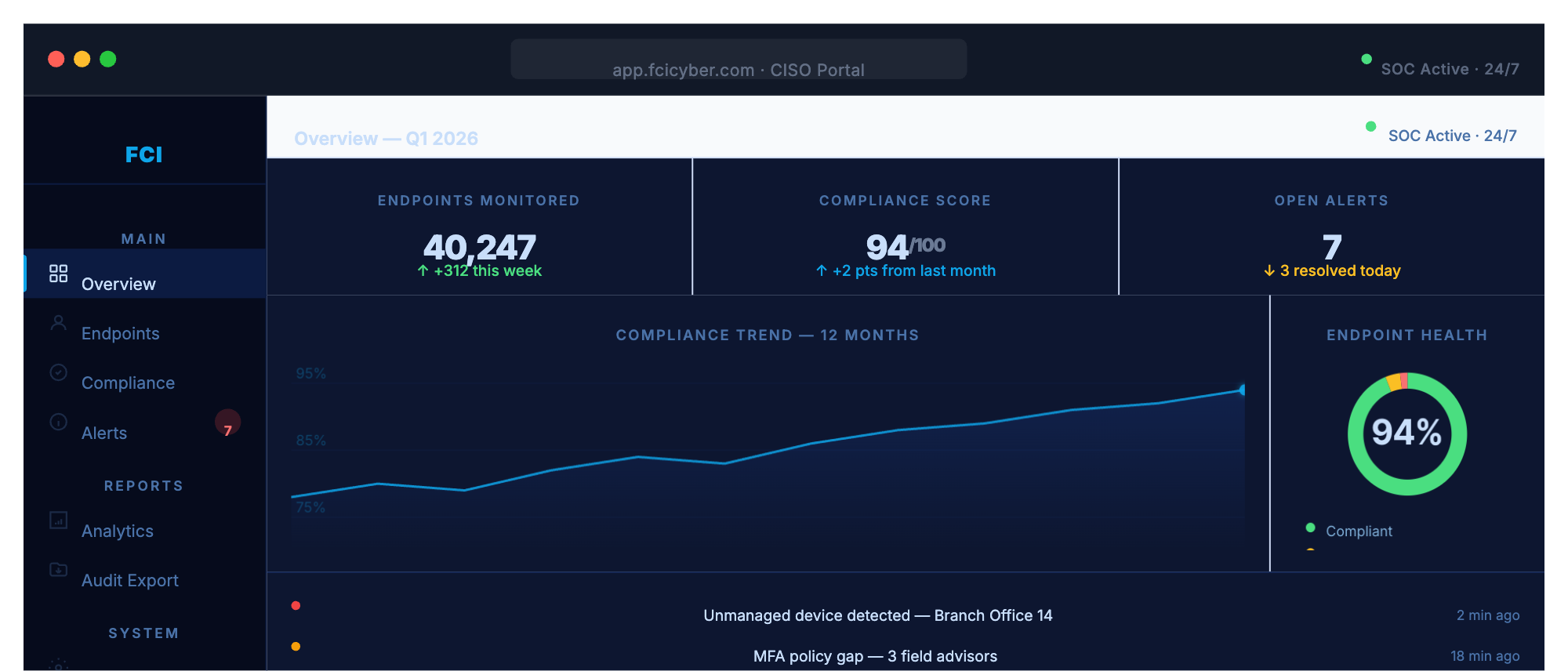
Support calibrated to the security officer you have.
The title “security officer” means different things at different levels of a firm. FCI meets each where they are.
At the home office. You already run the program. The challenge isn’t learning the job — it is extending visibility and enforcement into every branch, every agency, every advisor device your team cannot physically see. FCI becomes the operational reach of your program, with evidence the home office audit will accept.
At the branch or agency. The role may be new or inherited. The regulatory tasks don’t wait. FCI walks through those tasks one at a time, evidences completion, and builds competence through execution.
“What they like most about the FCI Portal is that it helps them to be successful at becoming a CISO.”
— Brian Edelman, Founder & CEO, FCI
Not a one-time audit. A continuous cycle.
FCI runs a structured security assessment across all six domains — broader than a penetration test alone. The firm remediates what the assessment surfaces. FCI then re-runs to verify the fix, so the finding isn’t a static report — it is a moving picture of the firm’s posture that converges toward compliance over time. The result is evidence that reflects what is enforced today, not what was written last year.
When there is no patch yet, there is still a response.
When a critical vulnerability emerges — especially a zero-day, where no vendor patch exists yet — most firms wait. FCI doesn’t. FCI designs a compensating control to mitigate the risk and deploys it across every client simultaneously, until the permanent fix ships. The security officer sees the response in real time through the FCI Portal. Individual IT firms can’t operate at this speed or scale; by the time they patch one client, the next one is exposed.
The team that has done this before.
Containment, remediation, documentation, and communication in the hours and days after an event. FCI has handled thousands of incidents across financial services. The SOC is 24×7 and U.S.-based. When an event requires Microsoft-level access — a locked-out global admin, a compromised tenant — FCI’s Microsoft Partner access provides a recovery path most IT firms don’t have.
The technical voice in the room with your regulator, the FBI, and your cyber insurer — with the evidence to back it up.
When the forensics conclude, the firm has to present the results to people whose questions are technical and whose consequences are large. FCI stands with the firm in those conversations as the technical representation. The firm’s voice remains the firm’s voice. But when the question becomes what exactly happened, when did it happen, and what controls were in place at the time? — FCI has the answer and the documentation to support it.
In one case, FCI worked alongside the FBI to clear a client whose firm had been cited as the FBI’s primary suspect in a $700K wire-fraud incident. After an IT provider turned off MFA to simplify a Windows upgrade, a phishing site captured credentials and a bad actor wired the funds. FCI identified the breach, proved what had actually happened, and — working with the FBI — recovered the money for the rightful client. Read the case-study summary.
How FCI Is Different
Every provider can assemble tools. Not every provider can produce evidence the firm can show.
The difference between FCI and everyone else is not the tools — it is what happens when mastery, automation, consistency, and persistent compliance are applied at firm scale, every day.
Interconnection
Firm security is the domain that makes every other domain visible and provable.
Firm security connects all six domains. Without it, every other domain operates in isolation and evidence is scattered. With it, the security officer has a unified view of the entire firm’s security posture.
What You Can Prove
Evidence that builds itself — every day, not just on audit day.
Regulators, home offices, and cyber insurance carriers all ask the same question: can you prove it? FCI produces continuous evidence as a byproduct of how it operates. There is no scramble before an exam. The proof already exists.
Firm security — common questions
Ready to see what firm-wide security visibility actually looks like?
FCI works with broker-dealers and branch offices, insurance carriers and agencies, and RIAs. Start with a gap analysis — in 30 minutes, you’ll see where your firm stands across all six domains.